
So, you’ve got a big idea and you’re ready to hustle. But before you can start bringing your new venture to the world, we need to handle the BC business basics. Here’s exactly how to move from “I have an idea” to “I own a business” in five steps.
1. Ideate & Research: The “Vibe Check”
Before you spend a dime or waste a bunch of your time, you need to know if your idea actually has legs. I like to keep it simple and ask four key questions:
- What is the problem I am trying to solve? If there’s no pain point, there’s no product.
- How am I going to do it? This is your unique spin on the solution.
- Who is the key audience? The closer you can target in, the better results you can drive. Remember “everyone” is not a target.
- Who else is doing something similar? Research isn’t just about spying; it’s about seeing what’s missing so you can fill the gap. It also validates that your idea is not already out there.
2. The Name Game
In BC, your business name isn’t official until the government says so. You’ll need to submit a Name Request via BC Registry Services.
Before you fall in love with a name, you need to do your homework:
- The Search: Check the BC Business Registry to ensure your name doesn’t overlap with someone else. To be approved, it needs to be unique and identifying—think of it as your brand’s DNA.
- The Digital Real Estate: Don’t forget to check Google Domains or GoDaddy to see if the URL is actually available. There is nothing worse than picking a name only to find out the .com is taken!
- The Suffix: You also need to choose your business type. If you are planning on incorporating, your name will end with a legal designation like Ltd., Inc., or Corp.
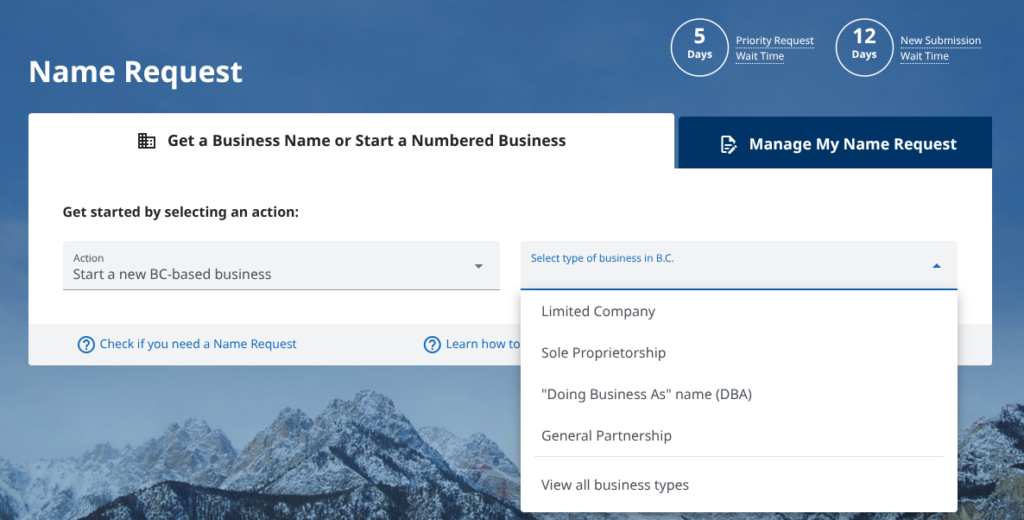
It costs $30 to register a company name in BC.
3. Register or Incorporate
While you can start as a sole proprietor, incorporating is often the goal. It turns your business into its own “legal person,” separate from you. This creates a protective shield for your personal assets—like your car, your savings, and your peace of mind—and gives you a massive professional edge when you start signing high-level contracts or hiring a team.
Once your name has been approved by BC Registries, you will be emailed a link to a form to officially “birth” your business. This is where you finalize the details. You will need to declare your chosen business structure as well as your Registered Office Address (company address), your Nature of Business (what you actually do), and the names and addresses of your Directors (who owns the company).
It costs $350 to register or incorporate your business.
4. Secure Your Business License
Registration is provincial, but licensing is local. Whether you’re in Vancouver or the Valley, your city wants to know you’re operating. If you’re a mobile business (like my plumbing company!), look into Inter-Municipal licenses. These licences can be added onto individual city licenses that allow you to work across city borders without a mountain of separate paperwork for every single town. It typically costs $160-$350 for a municipal business license.
- Vancouver Business Licenses
- Richmond Business Licenses
- Burnaby Business Licenses
- Surrey Business Licenses
5. Open a Bank and Tax Account
Time to get the money flowing. You’ll need a dedicated business bank account. This creates a separation between your business assets and your personal allowing for simpler bookkeeping and accounting, as well as legal protections of your personal finances.
Below are some of the bank accounts I would consider for a start up
- The Big Bank Choice: RBC Small Business (I use this for my business)
- Pros: Great for digital transactions; easy to link an RBC Business Credit Card to build business credit.
- Cons: $6 monthly fee; extra charges for in-person support.
- Credit Union: Vancity Credit Union Independent Business Account
- Pros: Proactive with Lines of Credit; excellent in-person support; strong BC community partner.
- Cons: Higher monthly fees; slightly less advanced digital app.
- Digital Bank: EQ Business Account
- Pros: $0 monthly fees and high interest on your balance.
- Cons: No branches; no traditional lending or credit cards yet.
Finally, get your taxes in order so the CRA surprise you later.
- GST: Mandatory once you hit the $30,000 revenue threshold. You can register via Business Registration Online (BRO).
- PST: If you sell taxable goods or specific services in BC, you must register via eTaxBC. Note: As of late 2026, PST has expanded to cover more professional services, so check if your “9 to 5” falls under the new rules!
Pro-Tip: Once you have your Business Number, you can easily link your business account to your personal CRA My Account using the “Sign-In Partner” option (your bank login). This lets you manage everything from one dashboard.
Ready to hustle? I used these exact steps to launch a plumbing company while navigating my corporate marketing career. It’s no easy task, but it’s 100% worth it.
Which of these steps are you currently stuck on?
Let’s chat about it in the comments!

Leave a Comment